
China refutes allegations of harassment of an Indian woman from Arunachal Pradesh at Shanghai airport, claiming actions were lawful and reiterating its claim over the region.
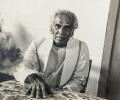
What appeared to be a generous act of friendship was, in truth, a manoeuvre within a much larger strategic game. The United States used the 1962 war not just to aid India but to test how far it could be pulled into the Western fold, points out Dr Kumar.

Arpi deserves to be complimented for the commitment and hard work that have gone into this production. The frustrations of seeking reliable documentation from the catacombs of the Indian bureaucracy did not deter him from going after the best information available, and the result is one that he can take much satisfaction in. Ambassador Prabhat P Shukla, Member Advisory Council, Vivekananda International Foundation, reviews Claude Arpi's The End of an Era: India Exits Tibet.

The MiG-21's sharp silhouette and supersonic roar will live on in the memories of those who flew it, those who maintained it, and those who watched it streak across the sky as a symbol of India's strength, asserts IAF veteran Air Commodore Nitin Sathe (retd).

About 30 airports have been either built or under construction in Tibet and Xinjiang provinces which will boost China's civil and military infrastructure in the remote regions bordering India, the country's official media reported.

Wing Commander Pratap Marathe's story is one of dedication, bravery, and humour, a shining example of the spirit of the Indian Air Force. Air Commodore Nitin Sathe (retd) salutes Wing Commander Marathe who passed into the ages last week.

'China did not expect India to show such strategic resolve in defending its territorial integrity.'
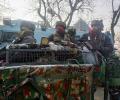
'On the LAC, China can undertake military action at any place with much fewer resources. It can do 'salami slicing'.'

The Tibetan nation still lives under the yoke of the Chinese Communist Party, and Beijing today has a guilty conscience; this creates a great uneasiness for Xi Jinping and his colleagues observes Claude Arpi.
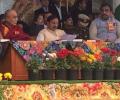
'It is very much a danger.' 'With Tibet following the India tradition of ahimsa and the global visibility of the Dalai Lama who embodies these values, he should be supported by India as a diplomat.' 'It would be in India's self-interest and instead of being embarrassed about his presence, India should recognise this (role).' 'By appeasing China, India does not get anything in return; they (the Chinese have not stopped) claiming Arunachal, part of Kashmir, etc.'

'It will be a repeated folly to ever think that China will not attack us.'

'The impression I get is bread and butter matters more than freedom and choice. And China is providing bread and butter in plenty.' Saisuresh Sivaswamy/Rediff.com takes the road less travelled -- to Tibet.

Silicon Valley can be replicated, but this will only be achieved so long as fresh talent is welcomed by both our countries - a move that will surely spark a billion ideas and discoveries.
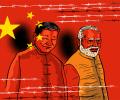
The reasons for China's negative response are located in its territorial dispute with India but also to its grand designs of dominating the region from its previous position of being merely a "balancer" between India and Pakistan, points out Srikanth Kondapalli, Professor in Chinese Studies at JNU.

'They know that India is no pushover.' 'We have to be extremely vigilant, remain ready and keep strengthening our positions.' 'We have to be militarily strong, whatever be the cost.'
'The general perspective -- certainly on Capitol Hill and Congress -- the love for India, the positive feeling for India still focuses on India as a democracy.' 'The more that Indian democracy and its pluralistic features is called into question by Indians, the more that same debate will replay back here.'

Though General Naravane's visit will not deal with 'impermanent' issues like the changing stands of politicians, it will certainly reinforce the deeper 'permanent' links between the people of Nepal and India. Time will hopefully tackle the present impermanence of the Sino-Nepalese romance, notes Claude Arpi.

'The fatal mistake for the USSR was the invasion of Afghanistan.' 'Quite possibly the fatal mistake for the Chinese empire is the assault on Ladakh,' observes Rajeev Srinivasan.

'I don't know who is deciding Indian foreign policy today. I don't know who is deciding how India deals with Pakistan,' former Union minister Ram Jethmalani takes on the Modi government.

When Meenakshi Arvind and Mookambika Rathinam took an epic car journey from Coimbatore to London, they encountered a world that was more good than bad. In the cry for freedom in a dark corner of the globe, they discovered that The Mahatma remained India's greatest icon.

'The one thing India has over these two States, whose toughness awes us, is our ability to embrace diversity with ease. 'The way ahead lies in learning from Vajpayee's method, not in Xi Jinping's,' says Shekhar Gupta.

Mahesh Rangarajan, director of the historic Nehru Memorial Museum and Library in New Delhi, tells Sheela Bhatt how the first prime minister will always remain relevant, and the efforts being made to keep his legacy alive.
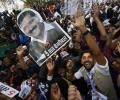
'I think the AAP is still in transition from being a movement to a political party so there is a mix of people who form the party. So there is somewhat of a overlapping and commonality of purpose.' 'Look at the way the government and party is functioning, not a single woman minister in the cabinet, or no woman member in the political affairs committee, it is all very tactical now.' 'After the 'sting' I decided to step back. I realised that my moral basis has been questioned by Kejriwal, it is truly despicable. He is around 15 years younger to me, I was aghast by his words.' AAP 'rebel' Prof Anand Kumar speaks of what went wrong with the party in the last few days in this interview with Upasna Pandey.
 © 2026 Rediff.com - Advertise with us - Disclaimer - Privacy Policy - Sitemap - Feedback - About us - Terms of use - Grievances